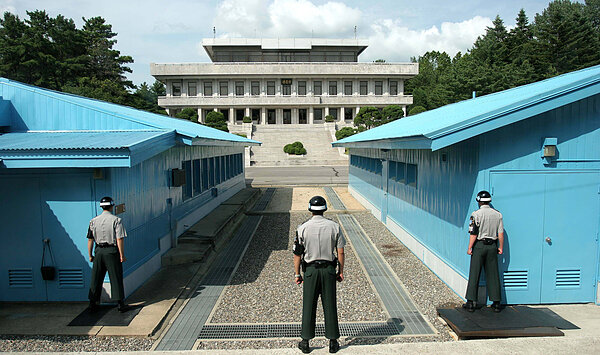
The new course Peace in Korea: Conflict, Diplomacy, and Reconciliation will allow undergraduates to spend spring break 2027 in Seoul for an immersion that includes visiting the Demilitarized Zone and collaborating with counterparts at Korea University.
Sharon Yoon, a core affiliated faculty member for the Liu Institute for Asia and Asian Studies and associate professor of Korean Studies at the Keough School of Global Affairs, developed the course and will lead the trip, which will accommodate eight undergraduates.
The course examines peace, conflict, division, and reconciliation on the Korean Peninsula through historical, sociological, and peace-studies perspectives. An important part of the Seoul immersion will be a collaborative workshop with Korea University that will allow Notre Dame and Korea University students to work together to understand complex problems of conflict and peace.
The course is supported by an endowed gift from Jaime Saul Hong '99, her husband, Steve Hong, and their young daughters, Charlotte and Emmeline.
"This is a rare opportunity for Notre Dame students to learn about Korea, not just through reading assignments and classroom lectures but by actually going to the region, seeing the Demilitarized Zone for themselves, and talking to experts on the ground," Yoon said. "Students will meet government officials, school teachers, North Korean defectors, and religious volunteers engaged in peace activism, while also engaging directly with Korean peers to envision new approaches to stability in Northeast Asia.
"I am deeply grateful to the Hong family for their generous support and enthusiasm for expanding experiential learning opportunities focused on Korea at the Keough School," Yoon added. "The spring immersion course will have a lasting influence on how our students understand and engage with Korea and Asia more broadly. "
The course, sponsored by the Liu Institute for Asia and Asian Studies and Kroc Institute for International Peace Studies, also includes individual research projects and a corresponding poster presentation. Paul Lee, a PhD student in peace studies and sociology, will serve as a teaching assistant for the course.
Undergraduates who are interested in being accepted for the course must submit an application by 11:59 p.m. on Friday, October 16 to be considered. Selected applicants will be interviewed, and those chosen as participants will be notified before November 6, 2026. Students enrolled in the peace studies supplementary major or minor, Asian studies supplementary major or minor, or global affairs major are especially encouraged to apply, but the course is open to any Notre Dame undergraduate.
The dates of the Seoul immersion are March 6–12, 2027. Participants will be eligible for travel funding from the Kroc and Liu institutes.
Course description
Nearly eight decades after the Korean War began in 1950, the Korean Peninsula remains divided under an unresolved armistice. What does it mean to speak of “peace” in a context where large-scale military conflict has subsided, but the political, social, and human consequences of conflict remain unresolved?
This course examines peace in Korea through historical, sociological and peace-studies perspectives. We begin by considering the distinction between negative and positive peace and then trace how national division, civilian violence, the Korean War, and the postwar US-ROK military order have shaped contemporary understandings of security, collective memory, and reconciliation. By analyzing contemporary challenges of peacebuilding in and around the Korean peninsula, we consider how different actors define peace, what kinds of change are required to move beyond the absence of war, and why efforts at peacebuilding and reconciliation have encountered political and institutional challenges.
This course includes a required immersion trip to Seoul during spring break (March 6-12, 2027). In addition to engaging directly with scholars, local civil society organizations, and fellow university students, the trip will involve experiential learning by visiting historically and politically significant sites such as the Demilitarized Zone. The immersion trip will provide an opportunity for students to strengthen their research skills and reflexivity about their own field inquiry projects as we bridge the gap between theoretical understandings of peace and practical applications on the Korean Peninsula.
For more information, please reach out to Professor Yoon at syoon5@nd.edu.